Žive naj vsi narodi
 Ki hrepene dočakat' dan
 Da koder sonce hodi
 Prepir iz sveta bo pregnan
 Da rojak
 Prost bo vsak
 Ne vrag, le sosed bo mejak!
God's blessing on all nations,
 Who long and work for that bright day,
 When o'er earth's habitation
 No war, no strife shall hold its sway;
 Who long to see
 That all men free
 No more shall foes, but neighbors be.
Every Slovenian, young or old, knows these lines. Not only do they form the penultimate stanza of France Prešeren’s most famous poem, Zdravljica (A Toast); they comprise the lyrics of Slovenia’s national anthem.
In its entirety, Prešeren’s poem is an ode to Slovenian ethnic pride and cultural unity. Its thinly veiled nationalism kept it from being published for four years after he wrote it, until 1848 when the Bourgeois Revolution swept through the Austrian Empire like a sudden fever wracking an aging curmudgeon. So I find it noteworthy that Slovenians have made this particular stanza of the poem their national anthem.[1] It’s an outward-looking, palms-up vision of international brotherhood without war or strife between nations that live together as neighbors. It could be the anthem of the European Union; it could be the anthem of the United Nations. So far, it remains just the anthem of Slovenia, a longing for balance between autonomy and accommodation.
In my opening post on why Jennifer and I lived in Slovenia for 7 weeks, I explained that I was seeking new experiments in civil society, as Alexis de Tocqueville did when he visited the young American republic in 1825. Just as de Tocqueville doubted that the equality of condition he saw manifested in the United States would take the same form in the nations of Europe, I doubt that Slovenian civil society today is a paradigm that can be copied everywhere. But, as the torch of progress in managing the interplay of individual and society in human affairs passes out of the bickering, self-centered, venal hands of U.S. leadership, I do believe Slovenia will be among the civil societies that carry the torch forward.
[1] The 1989 Amendments to the Slovenian Constitution refer to the entire poem Zdravljica as the basis for a national anthem. In March 1990, the National Assembly specified that just the seventh stanza, set to the music of Stnako Premrl, would be the national anthem. Slovenians seem satisfied with that focus.
Although this is my last blog about Slovenia, my love for that beautiful place, especially Ljubljana, will never grow old. This blog presents a video picture journey of our 2 months living there. So Žhiveli! to you Ljubljana—stay awesome.
What gives a civil society its identity? By identity, I mean something fundamental and essential, shared
by those who belong to that civil society, even though there are all manner of
differences and divergences in values and views among its members. Political
boundaries are both a consequence of and a contributor to the demarcation of
one discernible civil society from its neighbors, but political boundaries
don’t necessarily differentiate civil societies. The shifting boundaries of administrative
provinces and empires in the centuries before World War 1, or of nation-states
in Central Europe after that war, show that political boundaries may or may not
align with the kind of coherent social identity Alexis de Tocqueville wrote
about when he visited the young American republic in 1825. And was there really
just one American civil society back then, or were there perhaps five or seven,
or a dozen? Did the American Civil War leave a legacy of two quite distinct
civil societies: the states of the former Confederacy versus those that had not
seceded? Is there a single civil society in the United States today,
encompassing all 50 states, or is American society fracturing again—this time
along fissures defined less by geography and more by conflicting ideologies, like
the differences that fractured Britain in its Civil War?
Primož Trubar, Protestant priest and a translator in the early 1500s, authored the first printed books in Slovenščina. He is considered the founder of the Slovene literary language (from the Wikipedia article on Trubar, image is in the public domain).
Though Jennifer and I did not succeed in visiting every region of Slovenia, I would say Slovenians do share, and participate in, a single, coherent civil society. Yes, there are generational differences; there are differences between those on the political left and the right. The Istrian towns near the Adriatic Sea retain an Italian heritage, just as the farms and vineyards along the northern border have a distinctly Austrian feel. Nevertheless, wherever we traveled inside Slovenia, the people spoke of themselves as Slovenian and spoke of every other part of their country, with affection, as their country. And oh yes, they all spoke Slovenščina—that most difficult and arcane of Slavic tongues—even when they spoke other languages as well—typically at least one or two others fluently, and often several others at a “get by” level.
In my first post reporting on Slovenia, I noted that 83% of Slovenians self-identify as ethnic Slovenes. So ethnic identity could conceivably be central to defining their civil society. However, a number of my Slovenian acquaintances had a parent or grandparent from elsewhere in the Balkans, yet ethnic origins did not appear to make much difference in their sense of Slovenian identity. Instead, I suspect that linguistic identity—being a native speaker of Slovenščina—is more important to their Slovene identity than ancestry is. Much has been written about the central role of the Slovene language in the historic quest for autonomy. The statue that demarcates the center of Ljubljana—perhaps also the cultural center of gravity for all of Slovenia—commemorates not a statesman nor military hero nor mythic patriarch, but a poet, France Prešeren, a nineteenth-century patriot and champion of their language.
France Prešeren, with the muse of poetry inspiring him from just behind his shoulder, still watches over Ljubljana and all of Slovenia from his vantage point in front of the Triple Bridge across the Ljubljanica River.
I would go so far as to engage the theme of my last two posts, Slovenia’s centuries-long drive to balance autonomy and accommodation, to illuminate what language means to Slovenian identity. Particularly for Slovenians under the age of 40, English is their lingua franca, the language through which they converse with and accommodate the outside world, a world of non-Slovenians. And their command of English is amazing. But I suspect that even the cosmopolitan, globe-trotting youth of Ljubljana will hold onto, and pass on to their children, the speaking (and I hope the writing, as well) of Slovenščina. For it embodies and preserves the essence of Slovenian autonomy.
A poem by Prešeren, the original Slovenščina on the left, a recent English translation on the right. From France Prešeren: Izbrane Pesmi—Selected Poems, pp. 22-23, translated by Uroš Mozetič. Mladinska knjiga Založba, d.d., Ljubljana, 2017.
My sister LInda and her two daughters, Liz (R) and Jenny (L), were our first guest stars (June 19–23). Here they are on Ljubljana‘s famed Dragon Bridge.
Living in Slovenia’s capital, Ljubljana, for 2 months, I eagerly anticipated the planned arrival of family guests for our last 2 weeks there. My last blog talked about our being guests of a gracious Slovenian couple who didn’t even know us. This blog will delve into our role as hosts and highlight my top picks for showing guests what Ljubljana has to offer.
First to arrive were my sister Linda and her daughters.
“Ljubljana is a quaint, relaxing place that doesn’t seem like a capital city. Arriving there from Paris was like a big exhale.”
Linda
Here is a rundown of what we did with our first three visitors:
Brass Band on a Boat. The Ljubljanica (pronounced “lyuˈblyáːnitsa”) River, which runs right through Ljubljana, affords many sightseeing opportunities. One of these, featured during the summer, is a brass band on a boat, which you can enjoy as you walk alongside the river all the way through the old town. Here’s a snippet.
Lake Bled (half-day or full-day excursion). The excursion to Lake Bled is a must-do if you’re in Ljubljana for more than a couple of days. These pictures give an idea of the pristine beauty of the place. Linda and daughters took a guided van-tour option, available at the Slovenian Tourist Information Centre (TIC) near the Dragon Bridge.
Traditional “pletna” boats take visitors from lakeside to the only island in Slovenia.
View of Bled castle, on a precipice overlooking the lake
Lake Bled, view from the castle courtyard
Boat ride along the Ljubljanica River. The river is such an integral part of the city that you really must go out on it. The many different types of tour boats available are a good way to do that. Go to the Ljubljana TIC by Triple Bridge to get information on tour options; purchase tickets at your chosen boat’s dock along the river.
This wooden boat is my favorite—the prettiest and oldest, and named after the river.
On occasion, you can enjoy musicians playing on the boats, often as part of the music festivals held routinely in Ljubljana.
Friday Open Kitchen. Another must-do with guests is Open Kitchen, a collection of vendors representing the diverse range of restaurants in the Ljubljana area—from traditional Slovenian food to Italian to Thai to burgers and fries. Open Kitchen happens every Friday in summer, near the central market. Vendors offer perfectly sized portions at a discounted price. It’s a great way to people-watch as well! We ate at Open Kitchen every Friday we could—with or without guests.
Open Kitchen cook grilling up Slovenian-style sausages and other meats.
So many people to watch.
Panoramic view of Open Kitchen.
Funicular ride to Ljubljana Castle. The castle rises over the heart of Ljubljana and offers stunning views of the old city. So much history imbues this medieval fortress, which you can absorb during a “Time Machine Tour” where reenactors entertain while educating visitors about the castle’s storied past.
Reenactors playing Romans, for whom the high ground of the castle’s site likely served as a Roman army stronghold from the first through the early fifth centuries. Archeological surveys suggest that the castle site has been used by humans continuously since 1200 BC.
Ljubljana’s mayor saved the castle from ruin when he bought it for the city in 1905 for 60,200 Kronen, roughly $12,000 at the time. It took another 60 years before renovation of the castle began. Here a reenactor plays the mayor of the time.
Cankarjev
Dom, Dvorni Trg, and other music venues. Music festivals abound in
Ljubljana, especially during the summer months. You need only step outside and
walk around the city to catch fine classical, progressive rock, jazz, gospel,
and even American country music!
Gospel group called BeeGeesus 😊in the square.
Lady Gaga-esque performer in Dvorni Trg square.
Vendor shopping. With our extended stay in Ljubljana, we really got to know where the good vendors hang out, which, not surprisingly, is slightly off the beaten tourist path. When in Slovenia, it’s best to buy from craftspeople: silversmiths, carvers, glassblowers, chocolatiers, and more.
3-hour bike tour. We liked this so much, we repeated it with our next-to-arrive guests, my daughter and youngest son. Funny guides cover all the “hotspots” in Ljubljana. The expansive tour includes a snack of sausage, cheese, bread, and dessert, all wrapped up in a red cloth napkin. Sign up at the Slovenian TIC, where the tours start.
Taking a break from our bike tour.
The lovely casual tablecloth that Tomm Sibert made from all our bike-tour napkins, after our return.
Then Lindsay and Samm (2 of my 4 kids) arrived! During June 25–30, we packed in several planned activities, including a few repeats from the previous week’s guest agenda, plus a couple of happy surprises as well.
“Ljubljana felt much more like a community than a city. It was safe, cultured, and the food was amazing!”
Samm
“Ljubljana is an artsy and historical city rich with music and culture. I was blown away by how green the mountains were and how blue the water was. We should all strive to live as sustainably as this city!”
Lindsay
Reading along the river. They call it “the beach” in Ljubljana, but really it’s a long stretch of tiered cement bleachers along the river where people relax, read, make out, etc. We put our toes in the chilly water and just chill-axed on a hot summer afternoon, their arrival day.
Hostel Celica. This is a cool venue for music as well as lodging. Each guest room is a former prison cell converted into a coveted architectural work of art. Free music concerts are held in the former prison courtyard. The first night of Samm and Lindsay’s visit, we saw an Indian alt music group called the Bodhisattva trio.
Vintgar Gorge plus Lakes Bled and Bohinj. This excursion covered much ground. Samm and Lindsay swam in Lake Bled, hiked the gorge, and relaxed on the shore of beautiful Lake Bohinj (see pics below).
Prulček live music pub. Our home away from home while in Ljubljana. And it gave me one of my best nights of our entire visit. Why? Because of this:
Paddleboarding on the river. Such a great way to immerse yourself in the beauty of the Ljubljanica River without actually going in—at least not on purpose!
Lajbah. Our second home away from home, this cool pub offers a yuuuuge craft beer selection and a fun hangout for students, other locals, and tourists in the know. We played Crazy 8’s with the kiddoes. I won (it’s my card game).
Biking the Path of Remembrance. We rented single-speed bikes for Samm and Lindsay (from the riverside hostel H2ostel) and headed off to bike the Path of Remembrance (known as the POT). The POT traces the course of the barbed wire fence used by Fascist/Nazi occupiers during World War II to control movement into and out of Ljubljana. Erected around Ljubljana in February 1942, the wire fence and its bunkered control points turned the entire city into a virtual concentration camp. It is an important, though dark, part of Ljubljana’s history that we wanted to share with my kids.
House of Illusions. Wow. This visit was completely spontaneous but so worth doing if you’re ever in the city. It made us laugh out loud trying to solve the various puzzles, especially those put out for guests at the end of the tour. Lindsay, Samm, and Bob figured out five among them, earning us a free puzzle kit to take home. Smart peeps! Bonus: we got to see part of a dress rehearsal for an outdoor showing of the opera Aida, in the square outside the museum.
Shades of Alice in Wonderland. Expansive daughter on right dwarfs shrinking mom on left.
My head on a platter
The crazy mirror room, disco-like!
Bob doing his amazing gravity-defying handstand
This was a soul-enriching experience for me: transitioning from being welcomed guests in a foreign land to serving as hosts welcoming my own family to join us for part of the journey. Highly recommend!
My previous post examined how Slovenian civil society from the 7th century up to World War II could be understood as an evolving balance between local autonomy and practical accommodation to the political and military power of one or another dominating neighbor. This post will carry that autonomy and accommodation theme up to the present. I’ve described my major written and institutional sources for both posts here. This post in particular also draws heavily on what I heard and observed while talking with individual Slovenians during our 2 months living among them.
World War II: Slovenian Endurance and Resilience
Unlike World War I, when the beautiful Upper Soča Valley was
the scene of major offensives and counter-offensives in trench warfare, Slovenian
lands were not the site of major World War II battles. Instead, Slovenia and
the rest of what had been the Kingdom of Yugoslavia were occupied by
Mussolini’s Fascist Army, then Hitler’s Nazis and Hungarian Nazis. During these
four years, the historic balancing act between local autonomy and accommodating
powerful neighbors was replaced by a more fundamental will to survive through
endurance and resilience.
Jennifer has written about the occupiers’ encirclement of Ljubljana with barbed-wire fencing and machine-gun bunkers to control all access to that city. After the war, this 35-km line of encirclement became the Path of Remembrance and Comradeship around the city. The Nazi occupation became increasingly brutal and harsh, as frustrated occupying forces attempted to quell the growing Partisan resistance to occupation.
Dying Partisan. Memorial sculpture of a partisan falling after execution by firing squad, now in the Ljubljana City Museum
A complicating factor of this occupation was that even before WWII there were Slovenes who opposed the philosophy and political program of Yugoslav proponents of Communism. This opposition stiffened as Stalin led the Soviet Union deeper into brutal, repressive dictatorship. With the Italian occupation of western Slovene lands in 1940, many of those fiercely opposed to Communism began working with the occupying forces to defeat Communism in Yugoslav territory. In Slovenia, this cooperation evolved into the Slovene Home Guard (also called the White Guard): a collective term for military and paramilitary organizations that collaborated with the Italian Fascists and later the German Nazis to defeat the anti-occupation Partisans. Members of the Home Guard and their supporters were branded as Collaborators, a term that Slovenes who lean to the left still use to refer to those on the political right, whom they blame for the corruption that prevents progress and saps the national treasure. I heard other Slovenes remark that the (Communist) Partisans killed more Slovenes than they did Italian or German occupying forces. A historical fact is that, after the war ended, when British forces repatriated large numbers of the Slovene Home Guard from prisoner-of-war camps in the Carinthian part of Austria, the returning ex-soldiers were massacred by the Yugoslav People’s Army. Mass graves in Slovenia contain the remains of perhaps 100,000 victims[1] of retribution and “political cleansing” after the war ended.
Slovenia in Communist Yugoslavia
I wrote previously about how Slovenia’s 46 years as a state within the Socialist Federal Republic of Yugoslavia (Communist Yugoslavia) provides context for understanding cooperation and competition in Slovenian civil society. On November 29, 1945, the Kingdom of Yugoslavia was formally replaced by the Federal People’s Republic of Yugoslavia, a federation of six socialist republics governed by one political party, the League of Communists of Yugoslavia, with Josip Broz (Tito) as undisputed leader. Tito’s push to modernize and industrialize Yugoslavia accelerated the industrialization and economic modernization of Slovenia. These economic forces renewed and invigorated the centuries-old dynamic of pursuing local autonomy while accommodating external overlords. Autonomy was now expressed as “self-management” in Slovenian industry and agriculture and as local management of civil and social affairs, while the central planners in Belgrade, issuing directives for economic development and for the party line in politics and in every aspect of civil society, had to be somehow accommodated.
Especially after Tito’s falling-out with Stalin in 1948 and
subsequent positioning of Yugoslavia as a “nonaligned” third option between
Western capitalism and Soviet-style economic central planning, Slovenia greatly
increased its economic interactions with the liberal democracies of Western
Europe. For ordinary Slovenians, travel across the Iron Curtain borders to
Italy or Austria became relatively routine—so long as one followed the
unwritten rules for what could be taken out or brought back home. Meanwhile, Slovenia’s
leaders continued pressing for greater autonomy from Belgrade in matters
political and social, as well as economic. While Tito lived, Yugoslavia as a
whole, but Slovenia in particular, evolved toward decentralization (more local
autonomy, less control from Belgrade) and more freedom (relative to Communist
norms) in the arts, higher education, travel and commerce with the West, and
even political expression. By the 1980s, even though Slovenia represented less
than 10% of Yugoslavia’s population, it was producing a fifth of the nation’s
gross domestic product and a fourth of all Yugoslav exports.[2]
After Tito’s death in May 1980, a global recession halted Slovenia’s
economic development and unemployment soared. While Slovenian economic
modernization had moved it closer to a market-driven economy and cultural
pluralism, the rest of the federation had stagnated economically and socially. Slovenian
leaders wanted to move toward “market socialism” and at least a limited degree
of political pluralism, including competitive elections. The Yugoslav federal
leadership, particularly the Serbian Communist Party under the arch-nationalist
Slobodan Milošević, wanted stronger central control and Serbian dominance.
Slovenian civil society was ready to embrace secession from the federation, in
favor of political independence as a sovereign state.
The main administration building of the University of Ljubljana, founded in 1919. Despite obstruction and repression from the central government of both the Kingdom of Yugoslavia and Communist Yugoslavia, Slovenians managed to protect and sustain its liberal education mission. Today it draws students from around the world. Photo credit: rtf123.com
Political Independence—At Last
In January 1987, a group of Slovenian dissident intellectuals
published, as a special issue of the journal Novia revja, a set of 16 essays, titled Contributions to the Slovene National Program, calling for
democratization in politics and greater autonomy for Slovenia. The journal’s
editors were required to defend the publication decision in a public discussion
sponsored by the state. Although the editorial board was forced to resign, no
public prosecutions occurred. A year later, the political trial of four
journalists who had been writing articles critical of the Yugoslav People’s
Army catalyzed mass demonstrations that became known as the Slovene Spring.
In September 1989, the Slovenian Assembly passed amendments
to the 1974 constitution that included opening elections to parties other than
the League of Communists of Yugoslavia and asserting Slovenia’s right to secede
from the Yugoslav federation. That December, Slovene police forces thwarted an
attempt by Milošević supporters to overthrow the Slovenian leadership. And in
January 1990, the League of Communists of Slovenia walked out of the Congress
of the League of Communists of Yugoslavia, in protest against domination of the
congress by Serbian nationalists.
The spring 1990 elections for the Slovenian parliament and
the President of Slovenia were opened to opposition parties, and a coalition of
dissident democratic parties defeated the former Communist party in the
parliamentary elections. In a referendum on independence from Yugoslavia, held
on December 23, 1990, 88.5% of Slovenian residents voted in favor of
independence (94.8% of votes cast, in a turnout of 93.3% of voters). The Slovenian
parliament passed the acts making Slovenia an independent, sovereign state on
June 25, 1991.
The Yugoslav People’s Army reacted by mobilizing units stationed within Slovenia. The army’s
leaders anticipated a quick victory leading to reassertion of central authority
and an end to Slovenian independence. The military action was indeed brief—it
lasted just 10 days—but the outcome was not what the Serbian military
leadership expected. During 1989 and early 1990, the Slovenian government had
quietly restructured the Tito-era Slovenian Territorial Defense forces to
ensure command and control would remain with the Slovenian government. The
Yugoslav units that had been deployed, as well as their bases inside Slovenia,
were confronted by these Slovenian forces, aided by Slovenian civilian police
units. Even Slovenian civilians took impromptu action, such as blockading
Yugoslav advances with trucks. Skirmishes and limited, but serious, battles
continued for six days. On the evening of July 3, 1991, the Yugoslav People’s
Army agreed to a ceasefire and a withdrawal of units to barracks. The Ten Days
War was over. Slovenian casualties were 13 killed and 112 wounded; Yugoslav
Army casualties were 39 killed and 163 wounded.[3]
On July 7, representatives of Slovenia, Croatia, and Yugoslavia signed the Brioni Accord, under which Slovenia and Croatia postponed independence for three months, while Yugoslavia accepted Slovenian control of Slovenian territory and defense forces. The Republic of Slovenia was formally recognized by the European Community on January 15, 1992, and Slovenia joined the United Nations on May 22, 1992. The fourteen-century pursuit of local autonomy had now evolved into recognition, inside and outside Slovenia, as a sovereign nation, governed as a representative democracy with open, multiparty elections for its parliament and president. But political independence in the midst of a rapidly changing Europe brought new demands for accommodation.
The upper half of the grand staircase in the Museum of Contemporary History provides a timeline of key events leading to and following Slovenia independence from Yugoslavia.
Accommodation within the European Union
In February 1992, less than a year after Slovenia achieved independence, the members of the European Economic Community signed the Treaty on European Union (commonly called the Maastricht Treaty), the first of a series of treaties that restructured that regional economic organization into today’s European Union (EU). In the summer of 1997, Slovenia was included on a list of European countries invited to open talks with the EU about becoming members (accession). However, before an initial association agreement could be reached, Slovenia had to accommodate EU demands for changes to its 1991 constitution and property laws so that non-Slovenes could own real property in Slovenia. At the last minute, the Slovenian government was able to make the required changes, and this new dimension of accommodation led to EU membership in 2004. That same year, Slovenia was accepted as a full member of the North Atlantic Treaty Organization (NATO). On January 1, 2007, after meeting EU criteria for joining the euro currency union, it became the first post-Communism transition country to join the Euro area.
So by the time of our visit in 2019,
Slovenia had been using the euro as its currency for 12 years. When some of our
Slovenian acquaintances complained about bureaucratic red tape and regulations,
or excessive taxes on businesses, I would ask if they thought that EU
membership was to blame. I never got a response indicating they thought the EU
was the problem; rather, they would blame their own national or city government
for being too hidebound or bureaucratic. Some responses pointed back to
governmental inertia inherited from Communist Yugoslavia, but they did not see
the EU as limiting their autonomy. No doubt this little nation will have to continue
accommodating EU membership while preserving Slovenian autonomy where it
matters. But to me the future looks promising. After all, the Slovenians have
been working the dynamics of autonomy and accommodation for 14 centuries.
Slovenia’s national flag incorporates the white-blue-red tricolor first flown in 1848 in Ljubljana by student activists.
[1] Estimates of the number of Home Guards and their families who were executed and buried in mass graves in Slovenia vary widely. The 100,000 figure is an estimate of the total number of all bodies found in post-World War II mass graves in Slovenia. See Wikipedia article “Mass Graves in Slovenia.”
[3] My casualty figures are taken from Gow and Carmichael, pp. 18818. But I’ve seen slightly different statistics in other sources, such as in the Wikipedia article “Ten-Day War.”
Our amazing weekend away trekking through mountainous farmland dropping into sumptuous valleys began with a bike trip in 2018 from Cockeysville, MD to York, PA. At a rest stop on this ride (unofficially dubbed the “Gnome Roam” because of one resident’s magnificent display of gnomes alongside the wooded trail), I spotted Dejan Ernestl, or rather heard him. His baritone voice did not comport with his reed-like runner’s body, but his accent perfectly matched his Slavic features. “Excuse me,” I pried, “where are you from?” “Slovenia,” he answered. I was jubilant, launching into a breathless spiel about our planned trip the next year, and could we exchange emails, and might he recommend places to stay, sites to visit, drivers to hire, etc., insider info like that. “Sure,” he said, then gave me his email.
Dejan
and I communicated often during the intervening months—and he did recommend all
those things, but he also connected us with his close friends Tomislav (Tom) and
Metka. Once in Slovenia, we started corresponding regularly with this busy
couple, trying to zero in on a good weekend to come meet them and stay for a
couple of days in the “country” north of Ljubljana. Weather was an issue; cold
and rain gripped all of Slovenia for the entire month of May. Finally, the sun
came out and the weekend of June 15-16 got a green light.
OK,
picture this. We do not know this couple AT ALL, and they really know nothing
about us. AND we don’t really know our connection to them—a random runner I met
at a rest stop while biking! And yet, because their close friend connected us, if
only by email, they extended us the kind of hospitality that in our world goes
out only to one’s closest friends. Here’s how it went…
First, we took a city bus to the Ljubljana train station, then a commuter train to the end of the line, getting off at a town called Zadani Most. Tom, his wife Metka, and their little terrier Rozi picked us up and drove us to their vacation home in Luče. Such an adorable town, and a house with many special touches. The first evening we sat and talked and had a delicious homemade dinner by Metka of veal stew, polenta, and fresh cucumber/tomato salad. Lots of red wine, too, my favorite :). It was wonderful spending quality time with people who were interesting and fun to converse with, especially since most of our conversations with people in Ljubljana stayed on the surface. We talked about everything from our kids (of similar ages) to our travels in Slovenia, to U.S. and Slovenian politics.
Metka
Rozi
We
stayed in a beautifully decorated upstairs room with a B&B-style
four-poster bed and French windows that opened onto a square where the smell of
freshly baked bread wafted in from the bakery next door. It felt like a movie
set: neighbors with heads out their windows calling “Dober dan!” (Good day!) to
each other and colorful old houses with splashes of flowers everywhere.
The next day we drove together to Velika Planina, a high mountain plateau where farmers pasture their cattle during the summer. Breathtaking views with shepherds’ cottages and cows all-around us, it was a postcard that had come to life! We hiked for hours to the top (Rozi trotted along with us). When we returned to Luče, Tom pan-grilled fresh trout he had caught fly fishing in the Savinja river. So delicious! Before dinner, Bob and I had time to sit by the river and just relax. Again, we stayed up late, talking with our hosts. They are a fascinating couple, quite different from one another. Tom is the Slovenian equivalent of a jaded government worker in the U.S., not really interested in talking about his job, while Metka is effervescent about hers. After all, she is the Director of MICE (Meetings, Incentives, Conferences, and Exhibitions) for Thermana Laško, a therapeutic spa hotel for the upper-crusty.
Velika Planina, a mountain plateau where farmers take their cattle during the summer. We walked through their pastures!
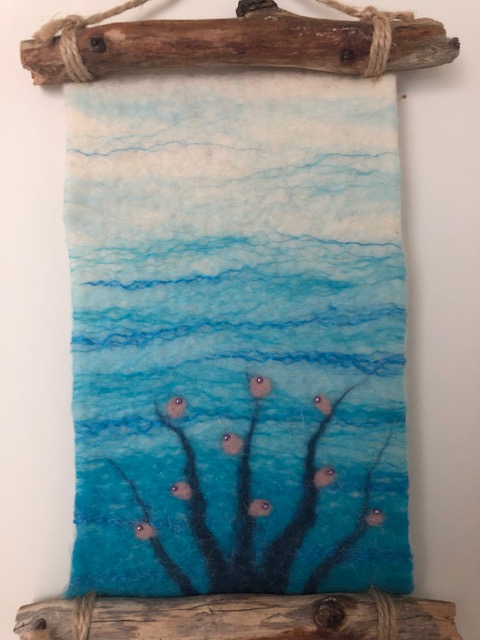
On Sunday, they took us to Solčava to learn about the Merino wool craft and other exhibits there. I bought a small wall-hanging, an ocean scene in pressed wool. We went from there up the newly re-opened Panoramic Road, which climbs into the Savinjan Alps, stopping to hike to Bukovc Farm and a mountain cottage. We also stopped at the halfway point on the Panoramic Road and saw a beautiful old church with cows in the yard. More gorgeous views, this time of the Logar Valley, which we later hiked into.
Metka and trooper dog Rozi in the stream at a mineral water source.
Walking into the Logar Valley.
The Church of the Holy Spirit, located at the halfway point along beautiful Panoramic Road.
After
a little more relaxing time at their house, we packed up and headed back to
Ljubljana, Tom taking us again to the train station. It was a magical
experience, all in all, even though I dropped my phone in a toilet at Bukovc
farm ☹, a minor
inconvenience compared with the amazing weekend they made for us and the lovely
people they are. We even got a followup email from Metka urging us to stay
longer next time because “in Kamnik Savinja Alps, there are many more places to
visit.” Sounds good to me.
Bukovc excursion farm at the foot of Mt. Raduha; at an elevation of 1,327 m, it’s considered the highest farm in Slovenia.
Part
of its vision as a smart, active, creative country is Slovenia’s emphasis on
green living. Concern for the environment and for sustainable development
appears everywhere you look, especially in Ljubljana. Indeed, the city was
voted a European green capital in 2016, a source of pride for Ljubljanians.
You cannot help experiencing Slovenia’s heightened environmental awareness and desire to further its green image.
For example, you cannot turn around without spying recycling bins, both indoors and outdoors. During outdoor activities, such as the Friday “Open Kitchen” in Ljubljana’s city center—where tourists and locals can sample food from vendors representing a host of local restaurants—the recycling bins are manned by city workers, lest anyone get confused about what trash goes in which bin. I am sure this initiative is targeted to tourists because as a guest, it can be a bit daunting knowing how to properly separate your trash. Slovenians are used to sorting and recycling; they forgo straws and plastic and bring reusable bags to market. We did (and still do) the same. Recycling bins are also in rental rooms, so we (and by “we” I mean “Bob”) always presorted our trash for placement in the appropriate street-side collection bins.
A set of single-stream recycle bins is a common site all around Ljubljana.
Most city trash can lids have tops that separate plastic, paper, and residual trash.
Even at the airport you will find a set of bins to separate your trash.
The evidence of green living as a cultural priority emerges
in the beauty of Ljubljana and other locations around this picturesque country.
Water is an especially important natural asset, with
Slovenia among the richest European countries in abundance of fresh-water resources,
offering four times the European average amount of fresh water per inhabitant.
Springs, creeks and rivers, natural and artificial lakes, and underground
aquifers enlarge this wealth of fresh water. Thus, it’s not surprising that
across Slovenia, the water is of exceptional quality and safe to drink.
Samm. Lindsay, and assorted fish swimming in the crystal blue waters of Lake Bled, one of many glacial lakes in Slovenia.
There are over 200 natural and artificial lakes and around 7,500 water springs in Slovenia.
Bob collecting a bottle of naturally carbonated mineral water from a spring at the base of Mt. Olčeva in the Solčava region of Slovenia.
The Soča River is an emerald-colored gem in the heart of the mountains and a paradise for kayakers, canoers, and rafters.
Respect for the environment in Slovenia emanates from a cultural love of the outdoors. All outdoor activities are popular there, from walking, jogging, and hiking to cycling, kayaking, and mountain climbing. Every Slovenian town has its “local peak”, which is usually a small mountain popular with the locals.Geographic biodiversity supports Slovenians’ active lifestyles, and so they preserve it. National, regional, and other parks are protected through the “Natura 2000 Network” that links the EU nations—think of Europe’s version of our National Park System and National Forests. Of all EU member states, Slovenia has the largest share of Natura 2000 sites, with 37 percent of its territory dedicated to these greenspaces.
Logar Valley in the Solčava Region is one of Europe’s most beautiful Alpine glacial valleys and winner of the international CIPRA Future in the Alps Award for successful management of this protected area.
I have never lived in a more beautiful place, and I will never forget it, even as I try to “up” my game at home with green practices. We still have a way to go to catch up with Slovenia in living green. To see what the greenest cities in the U.S. are doing, check out this blog by Josh Crank.
When I began studying Slovenia’s history, in preparation for
our first blog posts, I thought I’d be blogging about a 14-century-long push
for political independence against a long series of dominating—and often
repressive—neighbors. As I dug deeper, I learned that this first impression was
too simplistic. Instead of a continuing, if intermittent, struggle for sovereign
independence, I now see Slovenian social and political history as a dynamic
interaction between autonomy and accommodation.
Early Feudal Period: 600–1400 A.D.
Slovenes began moving into areas of present-day Slovenia in the second half of the 6th century A.D. In 623, they joined the tribal union of the Slavic King Samo to throw off control by the Pannonian Avars, an alliance of Eurasian tribes who came from the east. Both before and after the reign of Samo , the Slovenes of Carniola (roughly, today’s regions of Gorenjska, Notranjska, Kamniško Zasavska, Ljubljanska, and Dolenjska-Belokranjska on my regional map) were vassals of the Avars. Yet it appears they enjoyed some degree of local autonomy, as historical accounts refer to the Carniolans, as well as the Slovenes of Carinthia (the Kororška region and adjoining territory now in Austria) and Styria (Štajerska), as electing their own regional leaders, or “dukes.” Primož, our ebullient tour guide to Piran, even recounted to us the probably apocryphal tale that the Slovenian tradition of electing their local dukes under a linden tree had influenced Thomas Jefferson and the Founding Fathers at the time of the American Revolution.
The historical provinces of what is now Slovenia. The province of Carinthia included what is now the province of Carinthia in modern Austria (above the region of Carniola on this map). Graphic courtesy of World History at KMLA.
After the period of Avar domination, the Slovenian provinces
became part of Charlemagne’s empire (second half of the 8th century).
Subsequently, they became feudal fiefs of various Catholic bishoprics or
Austrian or German princes until the end of the 14th century, when the
provinces inhabited primarily by Slovenes came under Habsburg rule. Throughout
this period, these provinces continued to have a landed aristocracy that apparently
remained in charge of local matters, while owing feudal fealty to whatever
“overlord” happened to own the province at the time.
I’m condensing and simplifying a lot of historical detail [1] here to underscore a broad point. Throughout these first eight centuries, the Slovenes who lived in the lands forming what is now Slovenia practiced a substantial, though variable, degree of local autonomy—handling their own sociopolitical affairs, including most matters of commerce—while accommodating, in a practical way, the necessary feudal duties, taxes, etc., owed to an outside political “sovereign.”
Provinces of the Holy Roman Empire: 1400–1800
This interplay of autonomy and accommodation continued
during the next four centuries, when Slovenian lands were ruled by the Habsburgs
as provinces of the Holy Roman Empire. Provincial governors and administrators
were often outsiders sent from the imperial court in Vienna, but even local
aristocrats were increasingly more German, in language and culture, and less Slovenian.
In these conditions, maintaining a workable balance between local autonomy and
accommodation was neither easy nor without human cost. The peasants revolted in
1478 (in Carinthia), 1515, 1573 (Gubec’s Rebellion), 1635, and 1713. They never
won any of these uprisings, and their leaders usually died in the fighting or
were captured and executed. But these violent protests did force both local and
more distant rulers to ameliorate at least some of the commoners’ grievances,
rebalancing Slovenian autonomy and accommodation as medieval feudalism evolved into
absolute monarchy.
Painting by Oton Ivekovič (1912) representing the execution of Matija Gubec, leader of the 1573 peasants rebellion.
Slovenia in the Illyrian Provinces of Napoleon’s Empire
A brief but significant respite from accommodating Habsburg rule occurred at the time of Napoleon, when French armies moved east from Italy to occupy the Slovene and Croatian provinces, cutting Austria off from the Mediterranean. From 1809 until 1814, what is now Slovenia formed part of the Illyrian Provinces (reviving an ancient name for the lands bordering the east side of the Adriatic Sea), which were incorporated into Napoleon’s French Empire. The French governors of the provinces introduced important civil reforms, including the Code Napoléon, a fairer tax regime, (limited) separation of church and state, and equality of all citizens before the law (in principle, if not in practice). These reforms, accompanied by new notions of civil society arising from the French Enlightenment and Revolution, had major consequences for the Slovenian sense of national identity, modernizing the terms in which Slovenes thought about autonomy and accommodation.
The Illyrian Provinces included most of modern Slovenia and Croatia, as well as the Tyrol in what is now Austria. Ljubljana is located roughly at the top of the first “l” in “Illyrian.” Graphic courtesy of the “Illyrian Provinces” article on the Travel Slovenia website.
Slovenian Nationalism Emerges
The French army and governors were gone by 1814, but the
French occupation left behind a heightened or reawakened sense of national
(ethnic) identity among the South Slav “nations” (we might say “peoples”).
Interest grew in the Slovene language and culture and in political unification.
But political unification was not necessarily interpreted as political independence.
Even during the political unrest of the “bourgeois revolution” of 1848 and
through subsequent decades, political unity was more often expressed as winning
recognition for Slovenian (or Slavic) ethnicity equal to that accorded by the Habsburg
empire to Austrian and Hungarian ethnicity. The political progressives of the
19th century were typically more interested in making the Dual Monarchy (of
Austria and Hungary) into a Triple Monarchy than in declaring political
independence from the empire. The aim, in short, was again to balance autonomy with
accommodation.
An Independent Slovenian State—Briefly
World War I put an end to the Austro-Hungarian Empire. Encouraged by the victors’ principle of national self-determination [2] in remaking the map of Europe, the proponents of Slavic nationalism in Slovenia declared a “State of Slovenes, Croatians, and Serbs” in October 2018. Its territory would have comprised what is now Slovenia, Croatia, the Trieste region, and the part of Carinthia now in Austria. But Italy, with the connivance of its World War I allies (historians call it “the London Pact”), was already invading the Slovene provinces from the west and seemed ready to go all the way to Ljubljana and beyond. The newborn State of Slovenes, Croatians, and Serbs was forced to turn to the Kingdom of Serbia for military support against the Italian invaders. By the time the dust settled in 1920, Trieste and its surroundings were part of Italy, most of Carinthia was part of the new Austria, and the remainder of the Habsburg Slovenian provinces was integrated into the new Kingdom of Serbs, Croats, and Slovenes under the Serbian monarchy. Note the change in order of the three Slavic ethnicities, moving from the Slovenian-initiated “state” to the Serb-dominated “kingdom.” So yes, Slovenes had reconfigured autonomy and accommodation, but under duress.
The First Yugoslavia
At its creation, the Kingdom of Serbs, Croats, and Slovenes was a parliamentary monarchy with a Constituent Assembly to pass legislation. But ethnic and regional interests and animosities increasingly undermined its rapid succession of governments as parties and interparty alliances split and reformed like a superheated lava lamp. In June 1928, in the midst of bitter parliamentary wrangling over a treaty with Italy, a Serb deputy in the Assembly shot five members of the Croatian Peasant Party, including that party’s leader. In January 1929, King Alexander used the political crisis as a pretext for abolishing the constitution, discontinuing the Assembly’s session, and declaring himself dictator. The name of the kingdom, which had informally been known as Yugoslavia (land of the southern Slavs), was officially changed to the Kingdom of Yugoslavia. While Slovene political leaders remained more or less aloof from the inter-ethnic fray, the friction between Croats and Serbs grew. In October 1934, King Alexander was assassinated during a visit to Marseille, France, by an activist connected to Croatian and Macedonian revolutionary groups. Croats and Serbs continued to battle for power and control of ethnicity-defined territory until April 1941, when the Axis powers invaded and occupied the Kingdom of Yugoslavia.
The grand staircase in the Museum of Contemporary History is also a timeline of key 20th century events in Slovenia’s history.
During this turmoil, Slovenian politicians enhanced Slovenian local autonomy through creation of the University of Ljubljana (1919), Radio Ljubljana (which broadcast in Slovenian), a Slovenian national museum, and the Slovenian National Theatre. Elements on both the traditionalist-clerical side and the liberal-left side of Slovenian political life were pushing for still greater Slovenian autonomy within the kingdom—but not yet for political sovereignty. Even these more demanding factions within Slovenian civil society were still seeking to realize their own vision of an appropriate balance of autonomy and accommodation.
[2] In “national self-determination,” the “national” refers to a “people” as a nation (an ethnic majority in one geographic area), not to political nation-states. I did not realize that until I was reading about the Austro-Hungarian Empire as an “empire of nations”—which to us would be an empire of ethnic groups.
Slovenia has many traditions, among them handmade crafts of all types. You don’t have to look far to find them, since they appear in many shops, fairs, craft festivals, and the workshops of master craftspeople. The best will have earned the coveted Rokodelstvo (trans. Handicrafts) Art & Craft certificate, denoting the highest-quality products typically sold as tourist souvenirs.
After a few weeks of our living full-time in Ljubljana, we got to know where the good craftspeople were, whether vendor stalls stationed along the river, shops selling honey and chocolate, or excursion destinations offering specialty items, such as the beautiful felted/merino wool products (clothes, hats, accessories, toys, etc.) made by Solcava women from the wool of Jezersko-Solcava sheep. Check out their work here.
Here is a Solcava wool wall hanging I brought back for my friends Noelle and Paul for their second home by the water.
I loved looking for unique handmade souvenirs to bring back to our friends and family. Below are four categories of items I brought home, inspired by Slovenian tradition. All of them carry the distinctive mark of Slovenian authenticity and quality—that was a must!
Here is a working beehive showing the decorated front panels, which make a great Slovenia souvenir.
Painted beehive panels. Beehives are everywhere in Slovenia. In fact, among a population of just over 2 million, roughly 10,000 are beekeepers. The tradition of painting the wooden front panel of each beehive dates from the mid-1700s to the early 1900s, with scenes reflecting religious, humorous, historical, and everyday motifs. Only about 3,000 original beehive panels remain and are now stored in museums and private collections. However, you can still purchase hand-painted copies like this one I brought home:
Some say painted beehive panels are the best souvenir to get because this folk art tradition is so uniquely Slovenian.
Wooden
cutting board/display item. I bought this craft item for my oldest son and his
wife. Wood is a natural treasure in Slovenia, which
is the third “woodsiest” country in Europe after Sweden and Finland. Well over
half of Slovenia’s land is forested, and woodenware has been a Slovenian
tradition since the 14th century.
Traditional Slovenian woodenware like tools, spoons, wickerwork, etc. now also includes toys, accessories (wooden phone cases, glasses, jewelry), and beautiful cutting boards like this one
Bars of dark chocolate with salt are the best!
Salt chocolate. Ljubljana is home to many boutique chocolatiers offering a range of chocolate flavors, but the most Slovenian variety is the salt chocolate—especially dark chocolate with fleur de sel, or “flower of salt” from the Piran salt pans. Deemed a national treasure, the salts harvested there, along the Adriatic, have a flavor and texture prized by European epicures and chefs. The salt is gathered using techniques from the 14th century.
The Carniolan honey bee at work
Honey.
As a cradle of beekeeping and home to many excellent
beekeepers, it’s no surprise that Slovenia’s high-quality honey is a natural
delicacy in the country and a perfect souvenir to take back home. So many
flavors to try, each dependent on the type of flowering plant from which the
bees collected nectar and pollen.
A campaign promoting the role of Slovenia’s protected native Carniolan honey bee, as well as its honey and honey products, prompted the UN to declare 20 May World Bee Day .
Along with the items and products above, I also brought back other examples of traditional Slovenian crafts, including a hand-blown glass dragon, colorful candle holders, an ornate egg candle, silver jewelry, and, oh yeah, t-shirts and a stuffed Lipizzaner horse (for grandkids 😊). Most of these were purchased from the craftperson’s stall or from a boutique store, the kind of “small enterprise” businesses Bob talks about here.
In my previous post, I wrote about ways in which Slovenia’s
four decades as part of Communist Yugoslavia shape the context for cooperation
and competition today. In this post, I’ll recount some of the ways we found
cooperation and competition expressed in Slovene civil society during our
visit.
A couple of posts ago, I described how Slovenes’ personal enterprise often takes the form of a family enterprise: a cooperative venture among participating family members, crossing several generations. Another common aspect of this knack for enterprise is a keen sense of competition with other Slovenians to be the best in the business. For example, Primož Žgajnor described how a wine-improvement association with which he had formerly worked was able to get Slovenian wineries (many of which are multigenerational family enterprises, some following centuries-old traditions) to make the agricultural and wine-processing changes tailored for each farm’s soil, microclimate, and cellaring style. The association’s representatives would say “Your neighbor at [family name of the winery in the next valley] has taken our advice for his operation, and he’s getting good results.” Another example is Simon, our resident manager at Marta Studio, who wanted the family’s lodging rental business to become the best hotel in the city.
Entering the old wine cellar at the Žorž family’ s vineyard-winery in the Vipava Valley
Wine casks in the cellar of the Ščurek vineyard-winery in Goriška Brda
Primož saw this interpersonal competitiveness as a Slovenian
trait that could sometimes block progress. “Here’s a joke we tell on
ourselves,” he began. “How do you defeat a hundred Slovenes with a single
bullet? You throw a sausage into the middle of them, then shoot the one Slovene
left.” I still smile at this joke, but I also feel it misrepresents something
special I observed in the personal competitiveness and pride my Slovenian
acquaintances expressed. Their sense of competition never took the form of
putting someone else down: to be the best you can be doesn’t mean you denigrate
your competition. For instance, I was bantering with a waiter at Pizzeria
Foculus about how busy the restaurant was and what that meant about the quality
of their pizzas. “Well, I won’t say we have the best pizza,” he replied, “but I
will say we are one of the best.” The cut-throat competition that has been honed
to a potent business weapon in the U.S. doesn’t appear to have a toehold in
Slovenian civil society.
The vaulted ceiling of the inside dining room at Pizzeria Foculus, Ljubljana
This regard for one’s competition can open productive avenues for cooperation. With Primož’s account of working with competing wineries in mind, I asked Pavel and Anna Jarc (family members of a viniculture-based tourist farm) about the relationships among the multitude of small vineyard-wineries surrounding them. They said there was competition, particularly with respect to the quality of wines from different wineries, but they also stressed the value of cooperating with other vineyard-wineries to bring more tourists and more business to their region. A neighbor initiated the idea of establishing a network of hiking trails that partly follow the local roads and farm paths and partly wind alongside and through the manicured rows of vines, creating a “vinotour” attraction. Creating and maintaining these trails requires joint effort by many of the vineyards. Many also participate in local festivals that celebrate seasonal traditions and showcase local crafts alongside the region’s wines and winery-based tourist farms.
A group of hikers stop in at Vino Jarc while enjoying the vinotour trails




 Katts' Eyes On Our World